
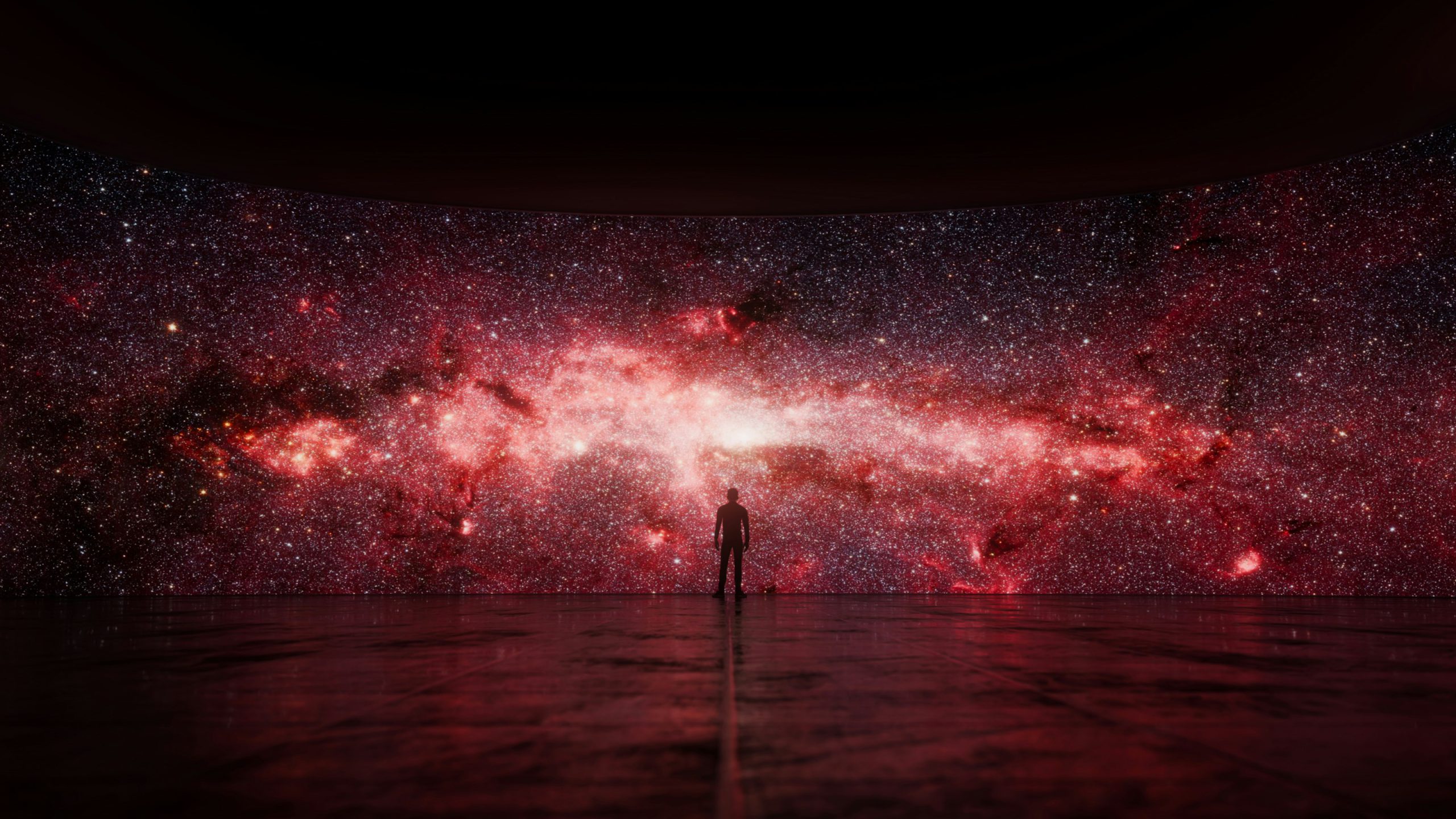
At the center of the universe lies the origin of the three physical dimensions: length, time, and mass. From that perspective, our individual lifetime may appear insignificant compared to the vast, dynamic cosmos. Stars are born and die over millions of years, galaxies drift and collide, and the very fabric of space expands endlessly.
And yet, within our brief span of life, we feel the full spectrum of human experience — happiness, joy, pain, anger, and sorrow. To us, time is not measured in cosmic cycles but in moments of love, struggle, and awareness.
The Cosmic Playground
The Vedas describe creation as līlā — divine play. The universe, with its laws of physics and its mysteries of origin, is not simply a mechanism, but a field of unfolding intelligence. In this field, both the immense and the intimate matter.
From the perspective of the infinite, our lifetime may be a flicker. But from the perspective of the self, every moment carries the weight of eternity. The playground of intelligence exists in this paradox — that we are both insignificant and immeasurably meaningful.
Religion, Dharma, and the Sanctity of Time
Religion has often been humanity’s way of honoring the sanctity of time. Through rituals, prayers, and ethical codes, we remind ourselves that time is not to be wasted in chaos but aligned with what is right.
In the Vedic vision, this alignment is called dharma — the principle that sustains harmony. To know right from wrong is not simply moral preference; it is participation in cosmic order (ṛta). When we live without dharma, time becomes squandered; when we live with dharma, time becomes sacred.
Distance, Time, and Mass
Einstein’s theory of relativity shows us how distance and time are not absolute but interwoven, shaping how mass behaves. The ancients, in their own way, hinted at similar truths: that the self (ātman) is bound to the body for a time, but its essence transcends measurement.
In human life, distances are not only physical. Each of us must travel inner distances — the journey from ignorance to wisdom, from selfishness to compassion, from darkness to light. These distances accumulate meaning over time. They give “mass” to our existence, not in kilograms, but in the weight of our deeds, memories, and consciousness.
The Center Within
If we search for the “center of the universe,” we may imagine it somewhere in deep space. But the Upanishads whisper another answer: the true center lies within. The infinite (brahman) and the self (ātman) are not two — they are reflections of one reality.
In the stillness of our own awareness, we touch that center. And when we act from that place, every fleeting moment becomes eternal, every small act part of the cosmic play.
We may not control the vast universe, but we are participants in its playground of intelligence. By honoring time, walking in dharma, and seeking the center within, we make our short lives radiant with meaning.
At the cosmic scale, our existence may be a flicker. But at the human scale, our every choice echoes across the web of life. That is the paradox — and the gift — of being at the center of the universe.
When you feel small in the face of life’s vastness, what anchors you back to your own center? Where do you find meaning in the brief span of your time?
Leave a Reply