
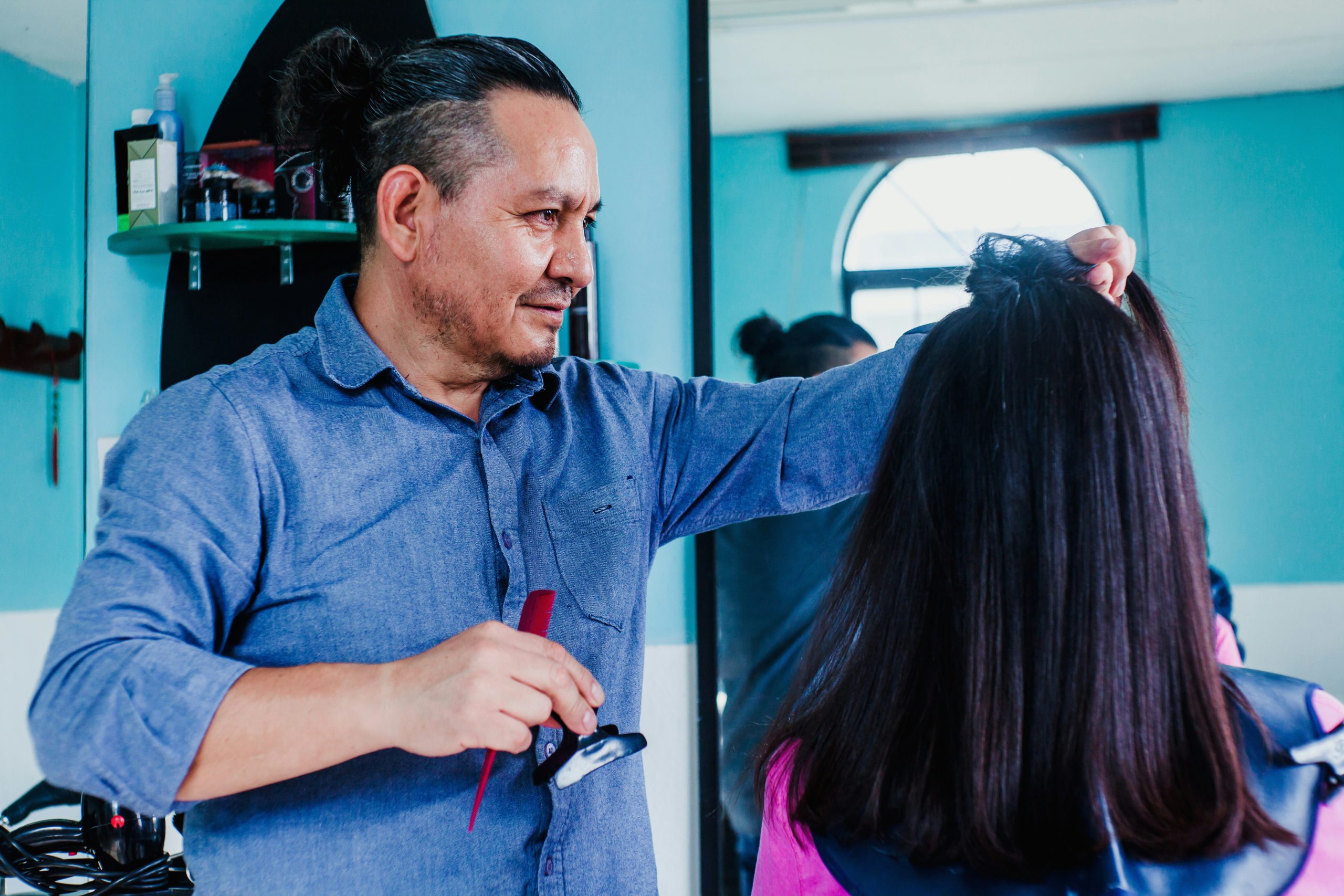
Imagine, for a moment, a world without the local barber under the tree.
For a modest fee — anywhere between ten and fifty cents — this craftsman provides a service far more effective than Gillette’s multi-million-dollar “Shave India Movement.” While ad agencies brainstorm slogans about smoothness, our man under the tree quietly keeps the faces of Indian men clean, their hair in check, and their dignity intact.
And for a small tip, he offers the ultimate luxury upgrade: a vigorous head massage with a fragrant, slightly suspicious herbal oil that smells like crushed mystery leaves and triumph. No fancy spa, no appointment — just instant bliss, delivered roadside, under the shade of a neem tree.
It’s not just a haircut. It’s social service.
The Economics of Simplicity
Now imagine this same barber — plucked from his humble patch of shade, retrained, and placed inside a L’Oréal Professional Salon.
Suddenly, his scissors are “artisanal,” his towel is monogrammed, and his herbal oil has been rebranded as “botanical scalp therapy.” He now works under track lighting, takes card payments, and has opinions about hair texture.
He has, in theory, moved up in life.
But here’s the catch: his new income, while apparently higher, now faces rent, tax, compliance, and the emotional cost of pretending to know what a balayage is. Meanwhile, the average man on the street — who once got a shave, a chat, and a life update for the price of a samosa — is left unkempt and unshaven, staring helplessly at the air-conditioned glass salons he cannot afford to enter.
If this sounds like a small problem, imagine the collapse of an entire ecosystem of affordable grooming. Unshaven men across the nation. Beards of rebellion everywhere. A national emergency in appearance.
The Forgiving Economy
Jokes aside, this is where India’s invisible genius lies — in its forgiving, adjusting, and quietly self-correcting society.
While economists discuss GDP and trade deficits, millions of small, unregistered entrepreneurs — barbers, cobblers, chai vendors, tailors, mechanics — keep this country running. They are the social shock absorbers of our economy.
They exist not because policy allowed them to, but because compassion did. Because people, for generations, understood that survival must coexist with kindness.
At independence, India’s founding values were not just political — they were personal. Compassion, tolerance, and humanity became unwritten economic principles. Sixty years later, those same principles still power our informal economy — one haircut, one cup of chai, one bicycle repair at a time.
The Unaccounted Economy of the Accountable
The irony is that this massive parallel economy — millions earning in cash, untaxed and untracked — is invisible to international accounting standards. Yet it is this very informality that sustains formality. The local barber may never feature in GDP reports, but he sustains productivity, hygiene, and human connection in ways that no quarterly spreadsheet ever can.
The barber under the tree is a metaphor for India itself: grounded, resourceful, adaptable, and quietly dignified.
Progress must not erase simplicity. Development must not sterilize character. The barber under the tree does not just give haircuts; he gives perspective.
And while the rest of the world debates growth in boardrooms, he reminds us that humanity is the original economy — and kindness its only lasting currency.
Who are the “barbers under the tree” in your own world — the people or systems that keep life running quietly while others chase headlines?
Leave a Reply