
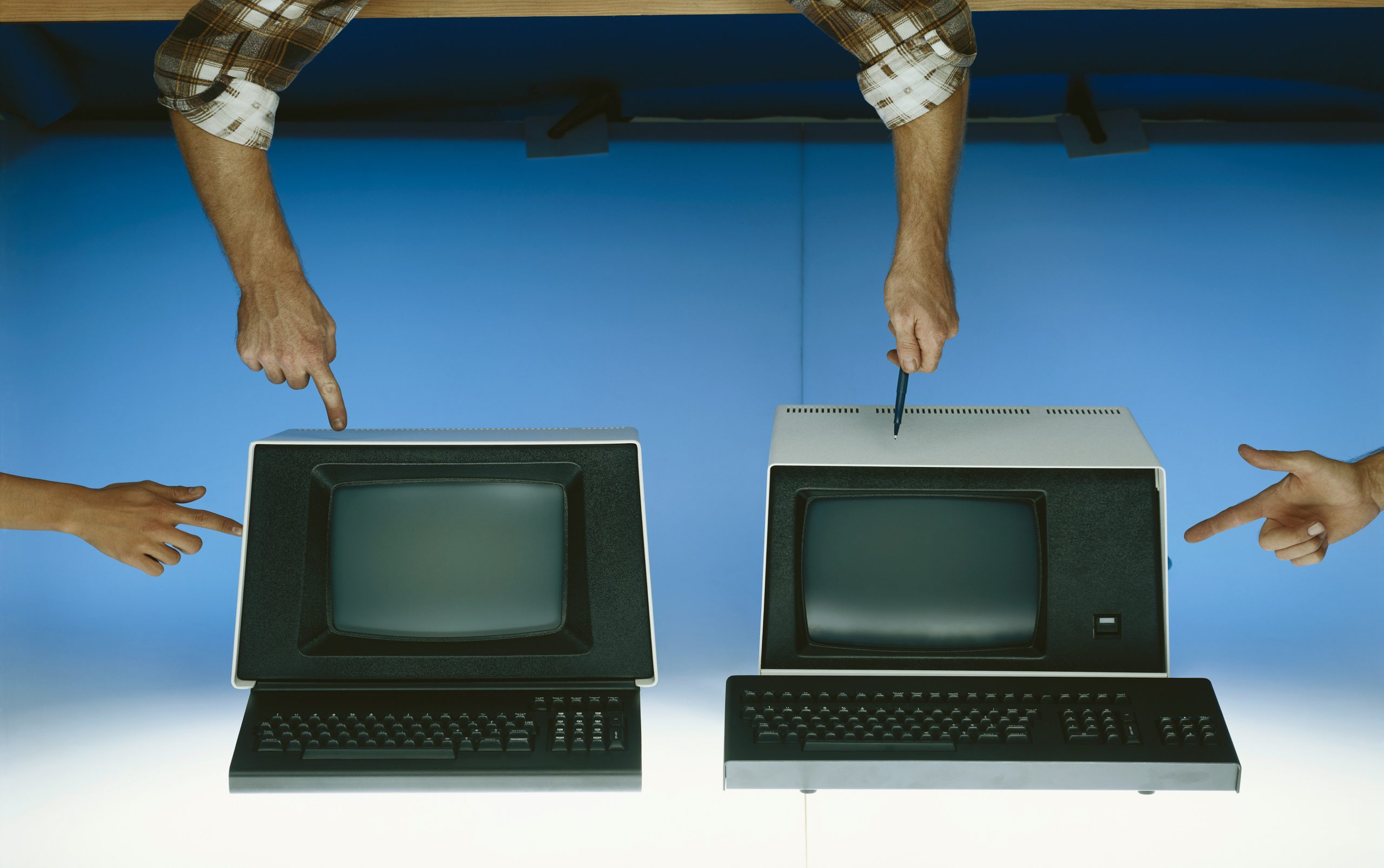
Progress has made machines smarter. But has it made us any wiser?
I write about technology. But today, I must write about the ever-widening gap that separates man and machine.
It’s not about processors or AI or the latest software updates. It’s about us — the humans who built them, and how we’ve lost the touch.
When machines were simpler, people were smarter
My first encounter with a computer was at home. It was the mid-eighties, and my mother — a working professional — brought one home to help with office work.
It had a 40 MB hard drive. Yes, megabytes. And it cost more than a small car today.
An elderly relative ran a small data-processing business. In those days, that meant serious innovation. Computers in India were rare; computer science was an exotic pursuit.
You didn’t “use” a computer — you studied it.
In school, I built a robotic waiter for the National Science Congress. By the late nineties, I was still carrying my project files on 1.44 MB floppy disks. There was one CD-ROM drive in the entire computer lab, and one more in the robotics lab — the kind of scarcity that made us careful and curious at the same time.
That curiosity was the real hardware of our generation.
The day my mother’s computer died
When my mother’s PC finally broke down, it had about 17 MB of text documents — years of her work.
Those were simpler times. Text documents were just text. Bold and underline were luxuries. Storage came in the form of 360 KB floppy disks — the size of an email attachment today.
We took the machine to a local technician. He opened it, replaced a few parts, reinstalled the system, and brought it back to life within a day. There was no data loss. The downtime was an inconvenience, but the solution was human. You could watch it happen.
We trusted the man behind the machine.
From knowledge to dependency
Fast forward to now.
My nephews — barely teenagers — know more about iPhones and iPads than most certified technicians. Yet, when a modern laptop stops working, even the so-called “genius” behind the counter often shrugs helplessly.
We live in an age of abundance: terabytes of data, solid-state drives, cloud sync, AI-powered diagnostics.
And yet, we’ve lost the fundamental literacy of technology.
When a system fails today, we are told, “It’s obsolete.”
When a drive crashes, the solution is, “Replace it.”
Solid-state drives — faster, tougher, smarter — are ironically less recoverable than the magnetic disks they replaced.
Progress has improved efficiency but diminished resilience.
The lost art of repair
There was a time when “computer technician” meant craftsman. Someone who could listen to a machine, hear the problem, and bring it back to life.
Today, “support” means escalation, remote diagnostics, and scripted troubleshooting.
If you work in a large company, your IT team can probably fix your device — or at least replace it overnight.
But in smaller offices, the story is different. The everyday user is left stranded, toggling between online forums and chatbot help desks.
Technology was supposed to liberate us. Instead, it has standardised us.
When everything connects, nothing is personal
Our refrigerators now order milk on their own.
Our thermostats adjust to our mood.
Our cars sync calendars, and our watches tell us to breathe.
We call it the Internet of Things — but often, it feels more like the Inconvenience of Everything.
Because when the network goes down, the refrigerator forgets, the thermostat resets, the car won’t pair, and your watch stops being smart.
And in that moment, the convenience turns fragile — and we realise how dependent we’ve become on systems we don’t understand.
Cloud storage, for instance, promises immortality for data. But try retrieving a gigabyte file with poor connectivity — and you’ll remember that the “cloud” is still bound by cables, weather, and time.
Complexity without simplicity
Computers today do extraordinary things. But for the average user, basic computing hasn’t become easier.
We still struggle with email setup, software updates, antivirus installations, and file management.
The tools have advanced — but the experience of control hasn’t.
Somewhere between command lines and voice commands, we lost the middle ground of understanding.
We became operators, not explorers.
The paradox of progress
The irony of our times is that the smartest machines are used by the least curious humans.
Technology has evolved from something we learned to something we buy.
And that transition — from curiosity to consumption — has widened the real gap.
We think faster processors and neural networks have made the world simpler. They haven’t. They’ve just made our ignorance more efficient.
The truth is: the gap in technology isn’t between hardware and software. It’s between man and meaning.
Closing thought
We used to fix computers.
Now we replace them.
We used to understand what was happening inside the screen.
Now we just hope it boots.
And while machines become smaller, faster, and smarter, the distance between our hands and our heads keeps growing.
Perhaps the next revolution in technology won’t be about artificial intelligence at all —
but about recovering human intelligence.
Leave a Reply